Tuesday, April 17, 2012

Philippines may soon own vast gas-rich area


By 
r

share4613 4376

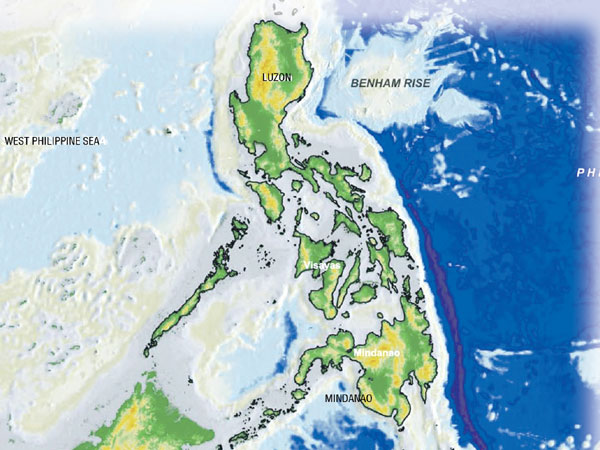
BENHAM’S RICHES The Philippines is the only claimant to 13 million hectares of an undersea region that contains huge natural gas deposits.
The Philippines will gain 13 million hectares in additional territory, an area slightly smaller than Luzon, should the United Nations approve next year the government’s claim on a region off the coast of Isabela and Aurora, Environment Secretary Ramon Jesus Paje said on Monday.
Paje said the undersea region, called Benham Rise, could turn the Philippines into a natural gas exporter because of the area’s huge methane deposits.
Studies conducted by the Department of Environment and Natural Resources (DENR) for the past five years indicate large deposits of methane in solid form, Paje said after a Senate budget hearing.
The government is only awaiting a formal declaration from the UN Convention of the Law of the Sea (Unclos) that Benham Rise is on the country’s continental shelf and therefore part of its territory, Paje said.
Legal basis
Once the Unclos establishes that Benham Rise is part of the Philippines, “we would have legal basis to enter into exploration agreements with private companies to explore… (the area’s) resources,” said Sen. Franklin Drilon, chair of the chamber’s finance committee.
Drilon said a favorable Unclos declaration would mean “increasing our territory from present 30 million hectares to possibly 43 million” with the inclusion of Benham Rise.
Discussion over Benham Rise generated excitement especially after Paje said that Philippine representatives were just awaiting one more meeting “to answer questions” before a special Unclos committee.
Only claimant
Paje said there was no reason for the Unclos committee not to issue a decision favorable to the country “since we are the only claimant, unlike in the western side (where the Spratly Islands are).”
“We have submitted a claim under (Unclos) sometime in late 2008. We got a reply from the UN lately (asking us) to answer some questions. They intend to pass a resolution sometime in mid-2012 to approve our claim (that it is) part of the Philippine continental shelf,” Paje told reporters after the hearing.
Records showed that the Philippines officially submitted a claim with the UN Commission on the Limits of the Continental Shelf in New York on April 8, 2009.
Davide submission
Hilario Davide, then Philippine ambassador to the United Nations, filed the country’s partial submission with the commission.
The United Nations says the continental shelf is “the seabed and subsoil of the submarine areas that extend beyond its territorial sea” up to 370 km (200 nautical miles) from the archipelagic baseline. An extended continental shelf goes farther than 370 km.
The Philippines claims that Benham Rise is an extension of its continental shelf.
Paje said Benham Rise was within the country’s 370-km exclusive economic zone.
American geologist
The environment secretary said an American geologist surnamed Benham discovered the area that was between 40 and 2,000 meters below the waterline in 1933.
“But we are able to define categorically that it is attached to our continental shelf only recently. We have proven (to) Unclos that it is attached. So now the UN is considering it for decision sometime in 2012,” Paje said.
He said gas deposits in the area would enable the country to achieve energy sufficiency.
“Benham Rise is very relevant because of its gas deposits (which has been) confirmed particularly by (the) National Mapping Resource Information Agency. It has given us the data that (the area) contains solid methane. We have not explored it but we have found nodules of methane in the surface and this is very important to us,” he said.
Kalayaan, Scarborough
The Kalayaan Island Group, which is part of the disputed Spratly Islands and Scarborough Shoal, both located in the West Philippine Sea (South China Sea) and claimed by the Philippines, are also believed to contain oil and natural gas.
Paje said there was the possibility that the country could export gas in the future.
The secretary added that there would be a demand for gas deposits in Benham Rise “because it’s much cleaner than (other) fossil fuels.”
The DENR formally submitted its proposed P16.99-billion budget for 2012 to the Senate finance committee.

When in Cebu City, please visit gregmelep.com and enjoy your tour.

Monday, September 19, 2011

Dutch firm to pursue solar projects in Philippines


By: 
nquirer
 3share5 2
The Netherlands-based Sunconnex Projects BV remains keen on building a 70-megawatt solar power project portfolio in the country despite the problems hounding the renewable energy sector.
The firm, through local unit Sunconnex Development Corp. (PH), is still willing to invest $3 million to $4 million to produce a megawatt of solar power in the country, or a total of about $210 million to $280 million for all its planned power projects.
However, Sunconnex is urging the government to maintain the stability of the country’s business climate by implementing the policies that had been passed under the Renewable Energy Act of 2008 and not to change the rules midway through the game.
“Sunconnex remains hopeful that the Philippine government will maintain stability in its policies to develop renewable energy including solar. Sunconnex hopes that the government will not change the rules and policies and proceed with the programs outlined in the RE Act,” said the local unit’s president JJ Samuel A. Soriano.
“Sunconnex was one of the foreign solar developers that responded to the Philippine government’s desire to develop solar energy as specified in the Renewable Energy Act and has been preparing and developing solar projects for the Philippines soon after the May 2010 elections,” Soriano added.
The Philippine renewable energy industry has yet to move forward as local and foreign developers currently await the issuance of the final feed-in-tariff rates, which would supposedly assure them of future cash flows since electricity end-users will be charged fixed amounts to cover production of energy from renewable sources.
FIT rates will likewise determine whether a renewable energy project would be economically feasible.
This early, however, several groups, along with the Board of Investments, have already issued their respective positions against the feed-in-tariff rates, generally noting that these will only further hike the country’s electricity prices, reportedly the highest in Asia.
Solar power developers, in particular, have been hit the hardest since under the FIT scheme, they have been given by the National Renewable Energy Board the highest rate at P17.95 per kilowatt-hour. This prompted groups and government officials, including Energy Secretary Jose Rene D. Almendras, to suggest the pacing of the more expensive RE sources like solar so as not to further burden Filipino consumers

Tuesday, September 13, 2011


Electric car hype hiding a quiet revolution

 0shareNew 0
BERLIN—Electric cars and hybrids may be capturing headlines and the imagination of green-leaning consumers around the world as one automaker after another announces plans to push into the brave new world of fossil fuel-free mobility.
But away from the spotlight, carmakers have been quietly delivering significant cuts in CO2 emissions with some re-engineering of internal combustion engines, technology advances, weight reduction and aerodynamic improvements. Increasingly stringent fuel economy standards in Europe and the United States that were mandated due to climate change concerns have been the main catalyst. Yet with rising fuel pricesand a waxing awareness of global warming, consumers have also been clamoring for more fuel-efficient vehicles.
“Carmakers have finally gotten the message and have made a good start in making cuts in CO2 emissions but only after they were forced to,” said Dorothee Saar, an industry analyst at the German Environmental Aid Association (DUH) in Berlin ahead of the Frankfurt international car show starting on Tuesday.
“Before 2008 they had only voluntary targets that were largely ignored. They’re moving forward now because they know if they don’t cut emissions they’ll pay heavy fines. They’re doing better but there is still a lot of untapped potential.” In the European Union, CO2 emissions fell 3.7 percent last year to 140 grams per kilometer after dropping 5.1 percent in 2009. Average emissions are down from 186 grams in 1995. The EU is on track to meet a 130 grams target by 2015 set in 2008 in the face of heavy resistance. The limit will be 98 grams in 2020. In the United States, notorious around the world for its gas guzzlers, the Obama administration announced plans in August to raise fuel economy requirements by 53 percent by 2025. The proposal requires companies to reach an average fuel efficiency across their US fleets of 54.5 miles pergallon by 2025.
“The industry has done what they have agreed to with the CO2 reduction goals but the problem is that they are aiming at moving targets,” said Philippe Houchois, car industry analyst at UBS in London. “The CO2 targets get tougher all the time. “Everyone has made good progress because they have to with the regulations,” he added. “There are no obvious laggards. But as the requirements continue to move, they are going to have to have sell more electric cars to be able to meet the targets.”
That is an important reason why many carmakers are turning to electric cars even if they now only represent a tiny slice of the global business—where about 50 million cars are sold each year. Until now only a few thousand have been electric. Even hybrids represent only a small slice of the pie so far.
Out of an estimated one billion vehicles on the roads worldwide, only 47 million alternative vehicles are running as hybrids, on hydrogen or electric power, according to a recent report by the Low Carbon VehiclePartnership. Electric cars, a key part of a low-carbon economy, have been on the minds of consumers with a green consciousness for years.
Green will be a major theme at the Frankfurt Car Show with an entire building—Hall 4—devoted to electric mobility. “Never before have the stars of the Frankfurt Car Show been so revolutionary, so green, so efficient, so quiet and so super clean as in 2011,” wrote Bild am Sonntag newspaper on Sunday. Tesla Motors made a splash in 2004 with its battery-powered Roadster while Mitsubishi’s i MiEV and Nissan’s Leaf followed. Nissan with its French partner Renault has sold 8,500 Leaf cars since it was launched in December 2010.—Reuters